
February Heart Logs, Part I
Becoming soft again


February 11th, 2026
Note: each of the italicized pull quotes throughout this entry are from the declaration made in Sophie Strand’s memoir, The Body is a Doorway.
Today I have allowed my sacred attention to stumble where it longed to go. I felt my heart drumming against my breast bone, and I felt my deep breaths leaving me shakily. I am a creature, yes, and some creatures know when they need to wail, scream, sob, quiver, sway, and collapse. This animal wisdom has always been more than just instinctual to me; I have chosen to pay attention to it, to honor it consciously, to recognize the gift that it is.
Unsurprisingly, like many of my fellow human creatures, my primary responses to overwhelming stress and debility for the past few years have been the ones I perfected when I was a wee developing being. I have shapeshifted expertly in almost every context I find myself, and I have locked away my true expression in a cavern in my chest. The energy required to make myself acceptable to others—and to the critics within me—drains me of vitality, creativity, joy, excitement, presence, and gratitude. The fatigue takes over; I stifle my grief and sorrow and anger and pain, and these veritable wellsprings of watery emotion, meant to flow in and out like a river that meets the sea, are dammed.
When I say that I am ready for the dam to break, I mean that I have every intent of setting the river free myself. I want nothing more than to feel the lifeblood of actual rivers, to be a vessel for spirited life to express its multitudinous magic through me. I want to break down all the walls that I have erected to keep myself safe from my own power in this world. I want to be a migration path for wild geese, monarch butterflies, human families, herds of caribou, wildflower seeds and mycorrhizal spores on the wind.
The developmentally traumatic circumstances of my childhood made it such that if I wanted to survive the abuse and neglect, I had to hyper-fixate on my surroundings and my family members. Chronic illness and disability onset in my early twenties made it so that I became hyper-fixated on myself and my symptoms; I could not ignore my body any longer.
But I do not want to be obsessed with my own narrative arc; I do not want main character energy. Lol. I want to honor myself while dissolving my protective ego and expanding my sense of selfhood to include all beings.
Modern masculinity is, at its core, a denial of human emotion and vulnerability. It is a hardening, a toughening, a self-righteousness that uses violence to discharge pain and grief. This level of horrendous, systematized abuse is on full display right now.
I don’t want to become hardened. I want to stay soft. I want to participate in the re-writing of masculinities, such as Sophie Strand’s work in The Flowering Wand. What about masculinity as courage, fierce protectiveness in the face of danger, generative creativity, erotic sensibility, stewardship of land and relationality? What about the Magician, the Lover, the Bard, the Healer?
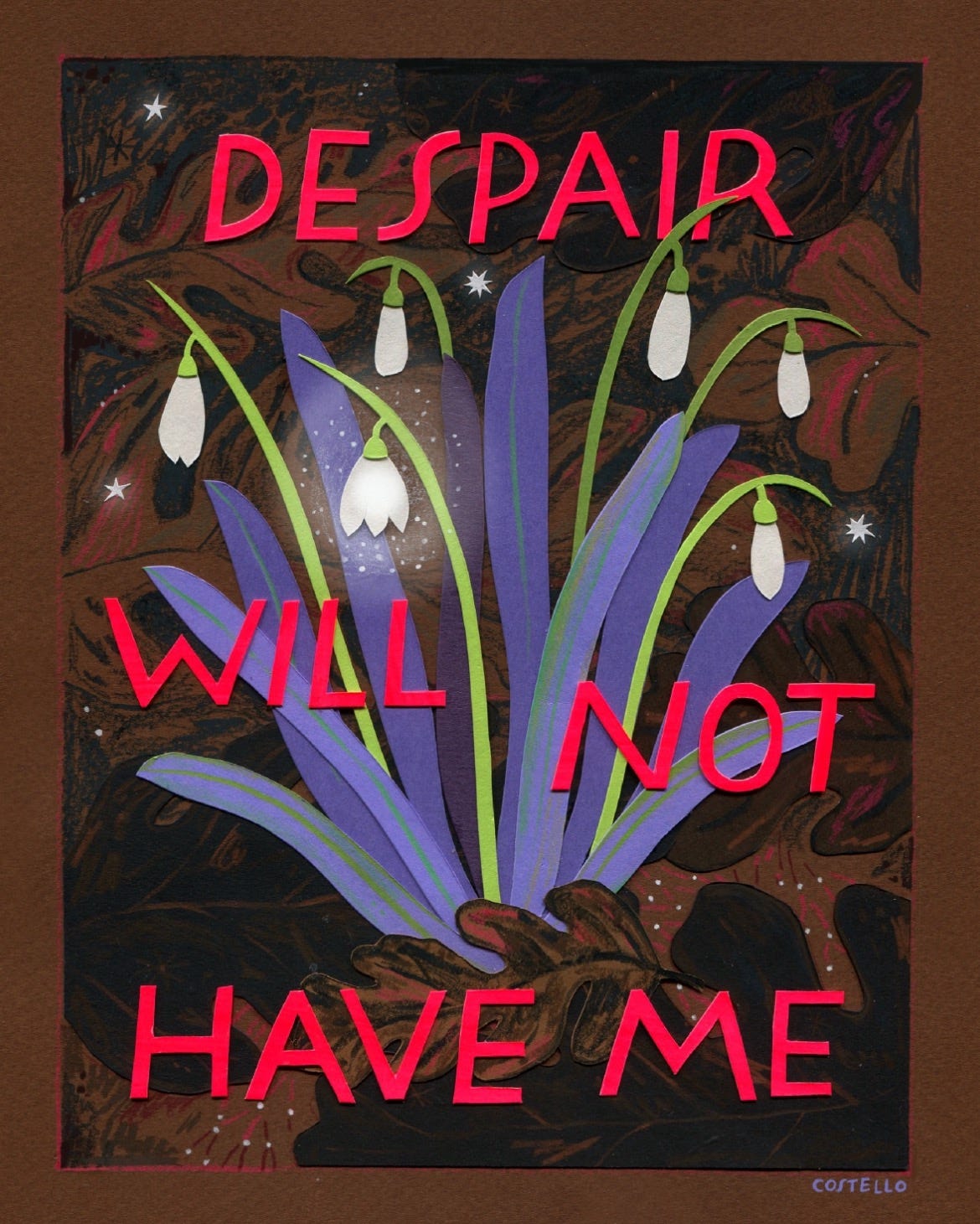
Last February I went to hear Irish poet Pádraig Ó Tuama give a talk in the chapel on campus, two blocks from my apartment. The name of the lecture was “Exploring Belonging in Times of Conflict & Uncertainty.” He spoke of old Irish prayers uttered by those under occupation by the British colonists, who would pray over their own deaths in the face of displacement and forced labor—praying for a good death, and recognizing one’s fate of becoming an ancestor. It reminded me of the seemingly unending prayer practices that can be seen and heard in occupied Palestine: the honoring of martyrs, the surrendering to Allah in the face of extermination and genocide. Palestinians have been under occupation for so long that many of them demonstrate trust in the long story of their inevitable liberation, even as the ethnic cleansing intensifies. Just as Refaat Alareer—who was deliberately assassinated by the Israeli military in December of 2023—said in his most famous poem: “If I must die / let it bring hope / let it be a tale.”
I try to fathom what it must be like to have your entire city carpet bombed while caring for disabled family members, or being disabled yourself, or becoming disabled by the bombs. The rage, astonishment, and helplessness that we have felt in witnessing Palestine for the past two and a half years pales in comparison to their lived reality of being trapped, cornered, starved, slaughtered, and orphaned. My mind and heart cannot possibly conceive of it. I often shut down in the face of it. But then I come back.
Pádraig Ó Tuama, in solidarity with Palestine, spoke of the necessity to continue giving our attention to the unfathomable. “Listen to the community of madness that you are,” he said. “Be courageous not in the face of your enemies, but in the face of your comrades.”
He also said that fear can become a distraction—a distraction from coming to terms with one’s own power.
I want to be brave with and for my comrades; I especially long to be brave in the face of our wounds bumping up against each other and preventing us from seeing the truth of our togetherness.
I do not want fear to be a distraction from coming to terms with my power. I am made of magic just like everything else.
I do not want to be a passive recipient of violent ideology. I refuse to be passive in the face of an inheritance of supremacist lies. I choose not to let fear dominate my emotional ecosystem. I want to feel everything, including fear, and also deep sadness and compassion and rage and pain and unbounded love. I want to be a conscious recipient of the miraculous gifts that this planet bestows upon us, an active participant in the sanctity of our interdependence.
For a few years I have been afraid to stay tethered to my spirituality because I was worried I would continue to fall into the traps that have been set by white, Western spiritual “teachers.” I was, and still am, concerned that I will cause harm by expressing sentiment resembling the eugenics of purity culture—you know, the ones that overload modern public displays of spiritual life: heal yourself completely, manifest your desires, reach enlightenment through discipline, blah blah blah. I have been enormously angry that these hegemonic trends convinced me that I was undeserving of care because I was too weak to “fix” my disability—i.e., to rise to the purest standard of able-bodied whiteness.
I became immensely reactive to these messages and doubled down on my survival skills. Ever since my traumatic breakup in 2024, when my animal self became convinced that relaxing long-term was never going to be a viable option, I have been even more vigilant of my surroundings than I was before. I have told myself that if no one else gets to have safety, I don’t deserve it either. I made endless concessions in order to cope with this fear and vigilance, including the never-ending distractions of menial task management and people-pleasing.
I hoped that I might be able to affirm my suffering as a reflection of the exhaustion required of me. I thought that if I pushed through the increasing intensity of chronic pain and fatigue and indigestion, I could be seen and validated as a disabled person, sure, but! one who does everything she can to make it all okay.
I vow to be incorrect.
I will let my joints dislocate, cracking open space for fungal incursions.
I will choose to take the wrong path…
It’s true that I have cultivated more bravery; I’ve learned to let my vulnerabilities be known and seen. I have become less afraid of asking for help or acknowledging that I do not have the same capacities as I once did. And yet, there are parts of me who continue to flood me with shame for “doing it all wrong.” Let’s face it, for being all wrong. I forget and remember, forget and remember… that this inner voice belittling me is not simply the abusive voice of my mother, but the poisonous voice of supremacy. I feel both embarrassed for living in this illusion for so long, and relieved to be pulling back the curtain once again.
White supremacy teaches supreme disconnect; therefore, I vow to reconnect. I vow to feel shit as often as I possibly can. I vow to feel immensely and courageously with others, with friends and lovers and chosen family members and comrades, and trees and mosses and earthworms and deep-sea critters, on and on and on. I want to be soft, messy, porous, like I was as a child.
So, today, when I felt the imminent panic rising in my body, I went into my room and returned to ritual to reconnect. I lit incense, I put music on, I opened the window, I closed the door. I rubbed my chest, I breathed, I cried, I howled into small pillows while hugging them. I rocked back and forth, I looked at the photos of myself on my wall—three, four, five years old—and I offered words of kindness to them.
I looked at my puffy face in the mirror and did not shy away, but instead served as a witness to my own pain, the pain of all the children in the world, the ones who have been kidnapped and detained and orphaned, the ones who are now adults without enough communal care and love. Most of all, I prayed. I prayed to the elements, to my ancestors, to my descendants, to my future self, to all my kin, to the great spirit that moves in me. I humbled myself and asked for guidance; I drew the dolphin card from my animal deck and felt the gentle nurturing nudges of this creature, the first faraway kin I fell in love with as a child.
I will hobble my way to the holy, stumble my way to the sacred.
I will finally honor my body as a material refusal to participate in this ecocidal culture.
I will finally honor my body.
I will finally honor my body.
Sophie’s words, written on a large piece of paper on my wall, moved me to more tears. I have struggled so immensely to honor my body, especially when it is in pain. I have rejected my body’s wisdom because I do not want to seem self-centered, escapist, dismissive, puritanical. I wanted to join the chorus of folks asserting their right to exist however the fuck they want to, the spectrum of agonizing experiences that can be felt in disabled bodies. I wanted to center the pain because the pain is so often silenced.
I felt like I had to do external work only—go to specialists despite their dismissals, navigate the system, get a diagnosis, try new medications, find ways to be okay so that others can count on me. I said no to deeper emotional and spiritual work because it felt trivial, secondary to the material action that could save lives, including my own.


And yet, I also know something about myself and my power. If I focus externally all the time, I become more inflamed because I lose myself in the unimaginable suffering on our planet. If I leave my body constantly, I become a shell. I find myself awash in despondency, self-loathing, panic, separation, and inevitable shutdown, for months on end.
Trying to be a vessel for liberation while incessantly shifting my attention away from my inner world has been like trying to breathe without lungs.
I have denied myself the distant memory of grace. I have not given myself permission to honor my body as a site of refusal and of magic.
I want to come back to magic again. Not just coping. I am capable of magic if I cherish my attention, my imagination.
That’s the thing about being sick and exhausted and immobilized most of the time; my attention is the most powerful magic I have when I am bedbound. I want to share my attention with those who are immediately near me—my cat, my garden, my platonic life partners, my watershed, the soil right outside my home, the mountains, the food on my plate. I want to imagine other worlds, unfamiliar life forms. I want to weep every day in gratitude, grief, and love for the world.
I want to feel my heartbeat and all of these co-arising heartbeats as magic—so that I might remember the magic of being in pain, too.
The pain tells me I am alive, and that I am interwoven with the fabric of everything. The pain prepares me for death.
This is why the fungi are my greatest teachers. They are entirely capable of going dormant when needed; conserving water and energy for future generations, and new iterations of growth and decay. They are also everywhere, always, expressing themselves in manners often incomprehensible. They are not afraid to shapeshift, to adapt, to turn otherness into selfhood and blur all the boundaries of life itself. They are collaborative, destructive, regenerative, ancient, enduring, resilient.
Fungi are the most diverse lifeform on the planet, and I like to think that they came here from somewhere else in the multiverse to transform this world into one of spectacular greenness and evolutionary magic. They have survived every mass extinction that has happened here, and they will go on surviving. I want them to move in me, through me, guide me, show me, allow me to feel, to connect, to blur the illusory boundaries that I thought could keep me safe. I want to feel it all so that I will be ready for planetary change when the extinction accelerates. I want to ride the fungal wave of interbeing into the future, dispersing spores of magic compassion for my descendants to find.
I will tie my roots to other roots permanently.
I will tie my roots to other roots permanently.
I won’t be trying to go it alone anymore. I will envelop my closest co-habitants in this web-weaving. I will be asking them to join me in refusing to be passive and overwhelmed, and instead choosing reconnective magic to defend the sacred.
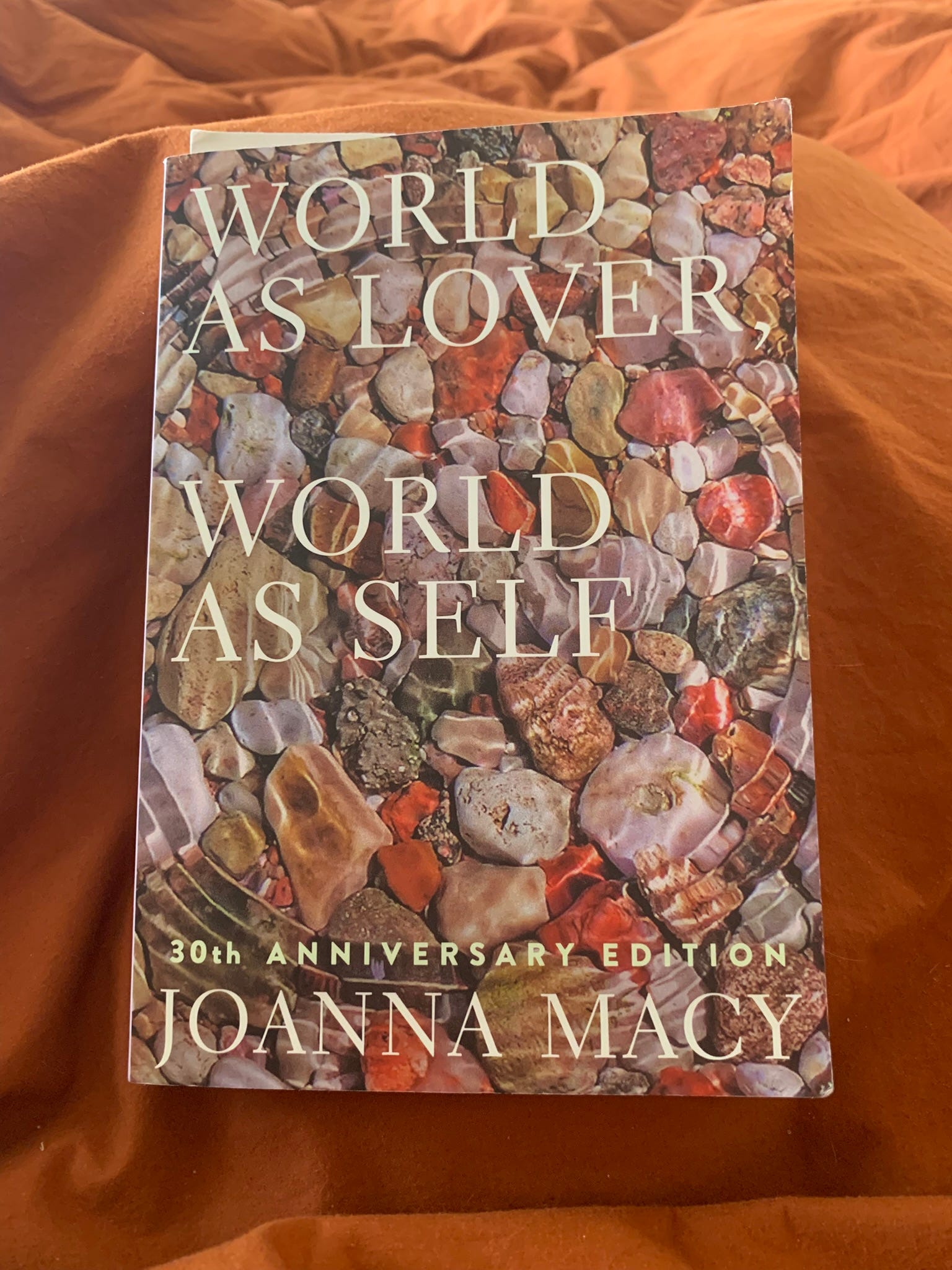
I have to thank the late Joanna Macy and her book World as Lover, World as Self for opening my heart this past week. Her timeless advice is to slow down, listen to the magic of our own breathing, and feel the heartbreak that we are destroying our world. The honest wisdom in her work has inspired me to come back to myself and remember the sacred—and, importantly, how I might be a vessel for that remembrance. She urges us all to become active accomplices in what she and her co-creators call The Great Turning: the collective shift towards a planetary society that is just and life-affirming.
“Moral distress is not only honored in all spiritual traditions, it also serves as wholesome feedback, necessary for our survival.
To recognize this brings us back to life: it’s okay for me to be here. It’s okay for me to weep for the horrors that have befallen all those oppressed and brutalized. It’s okay for me to weep for generations who aren’t even born yet.
That’s because I belong. That’s because I am part of the sacred living body of Earth.” —Joanna Macy
Thank you for reading my heart logs. I aspire to continue this practice throughout the year (in addition to my other writing endeavors). Fingers crossed that I will be rested and inspired enough to keep working on my book!! If anyone has advice about the publishing process, I’d love to chat~!